A one-page guide to how Ze is structured. For the full design document with rationale, wire format details, and performance analysis, see DESIGN.md. For the canonical architecture reference, see architecture/core-design.md.
Ze is a network operating system built in Go. Its protocol-agnostic Engine composes a ConfigProvider, a PluginManager, and the shared Plugin Server that implements the typed EventBus. YANG ConfigRoots select registry-loaded protocol and feature plugins; PPPoE and L2TP can register as lifecycle-managed subsystems. The Engine has no knowledge of BGP or any other specific protocol.
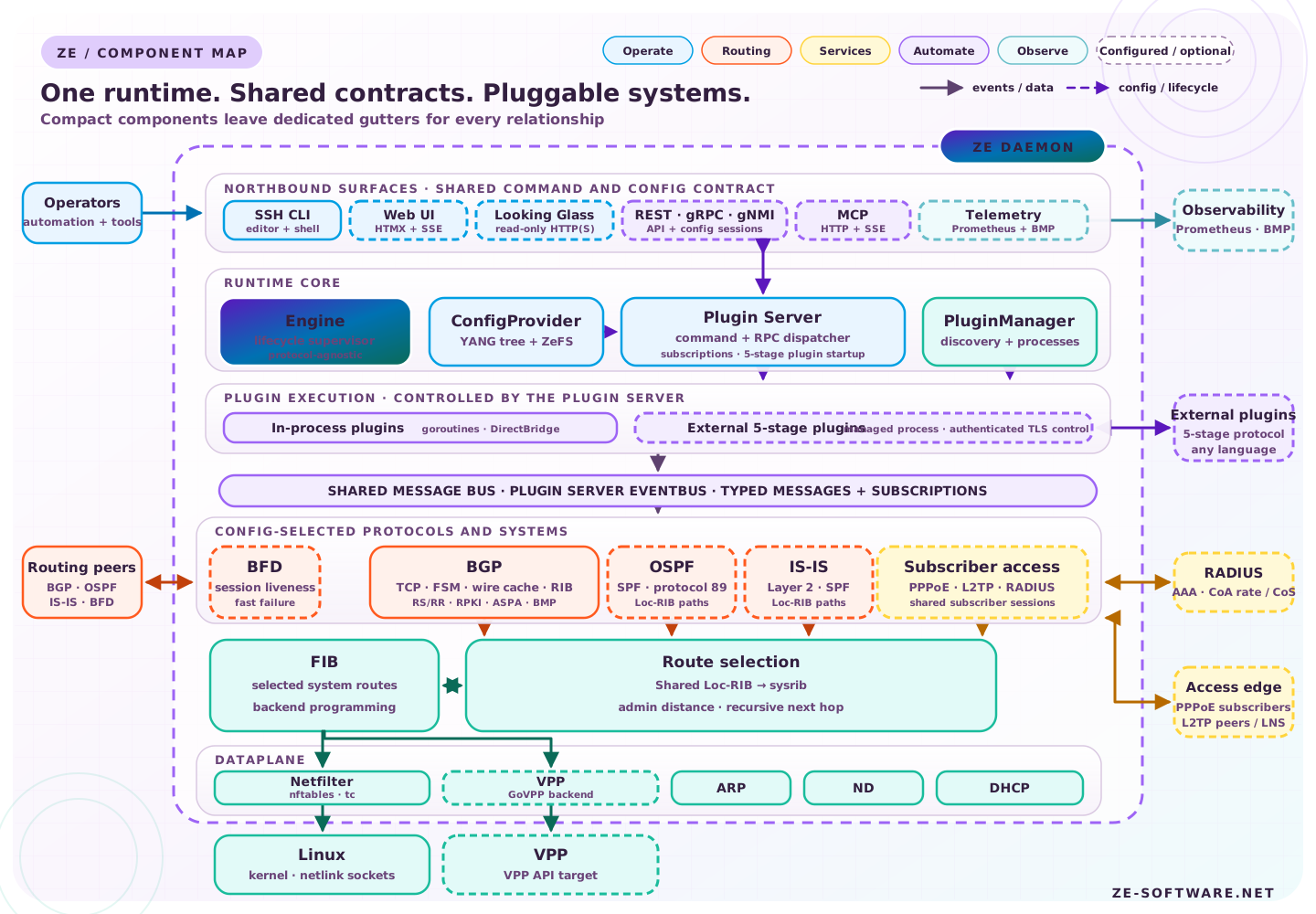 Ze components and their runtime relationships. Dashed outlines mark configured, build-dependent, or optional paths. Open the diagram for a full-size view; the text map below preserves the same structure for text readers.
ze daemon (registry-driven YANG runtime)
  |
  +-- Engine (protocol-agnostic lifecycle supervisor)
  |     +-- ConfigProvider (YANG tree and transactions)
  |     +-- PluginManager / ProcessManager
  |     +-- Configured subsystems (PPPoE and L2TP)
  |
  +-- Plugin Server (shared runtime backbone)
  |     +-- Typed EventBus, subscriptions, and event history
  |     +-- YANG command / RPC dispatcher
  |     +-- Registry discovery and five-stage plugin startup
  |     +-- BGP reactor and feature plugins (RIB, RS/RR, policy, RPKI, ASPA, BMP)
  |     +-- OSPF
  |     +-- IS-IS
  |     +-- BFD
  |     +-- Loc-RIB -> sysrib -> FIB
  |     +-- Dataplane: Netfilter -> Linux; VPP -> VPP; ARP; ND; DHCP
  |     +-- Interface, firewall, traffic, and other ConfigRoot plugins
  |     +-- Internal plugins (goroutines, DirectBridge runtime path)
  |     +-- External plugins (managed processes, five-stage control over authenticated TLS)
  |
  +-- Northbound listeners
        +-- SSH CLI/editor, Web UI, and Looking Glass
        +-- REST, gRPC, gNMI, and MCP
        +-- Prometheus metrics and BMP routing telemetry
| Principle | What it means |
|---|---|
| Wire-first | BGP messages are byte buffers, not parsed structs. Parsing is lazy via offset iterators. |
| Buffer-first encoding | All wire writes go into pooled, bounded buffers via WriteTo(buf, off) int. No append() in encoding. |
| Zero-copy forwarding | When source and destination peers share the same ContextID (negotiated capabilities hash), UPDATE bytes are forwarded unchanged. |
| Pool-based dedup | Per-attribute-type memory pools with refcounted handles. ORIGIN has 3 values; dedup saves memory at scale. |
| Registration pattern | Components and plugins register at startup via init(). Core discovers through registries, never imports directly. |
| YANG-modeled everything | Config schemas, CLI dispatch, plugin registration, and RPC discovery all flow from YANG modules. |
| Abstraction | Purpose | Location |
|---|---|---|
WireUpdate |
Lazy-parsed BGP UPDATE: iterators over wire bytes, no intermediate structs | internal/component/bgp/wireu/ |
PackContext |
Negotiated capabilities that determine encoding (ASN4, ADD-PATH, ExtNH) | internal/core/bgp/context/ |
ContextID |
uint16 hash of capabilities. Same ID = forward wire bytes unchanged. | internal/core/bgp/context/ |
Pool / Handle |
Per-attribute-type pools with refcounted handles and incremental compaction | internal/component/bgp/attrpool/ |
DirectBridge |
Bypasses IPC serialization for internal plugins (direct function calls) | pkg/plugin/rpc/ |
The Plugin Server is Ze's central runtime junction. It implements ze.EventBus
for typed publishers and subscribers, owns the YANG-derived command and RPC
dispatchers, coordinates plugin startup, and maintains subscription and event
history state. In-process subscribers receive typed values directly; plugin
process subscribers receive lazily encoded messages through the same fan-out.
There is no separate standalone bus in the primary YANG runtime.
Components avoid importing each other's implementation packages. Internal
plugins bootstrap through net.Pipe and use DirectBridge for runtime calls;
external plugins connect back over authenticated TLS. Route-producing plugins
write selected paths into the shared Loc-RIB. sysrib performs system-wide
arbitration, then publishes typed best-change events to FIB consumers.
The BGP subsystem owns the protocol: TCP connections, FSM state machines, wire parsing, capability negotiation, and the reactor event loop. It produces structured events and consumes commands. It never imports plugin code.
For a walk-through of the BGP state machine, see bgp-fsm.md.
JUNOS-like hierarchical syntax: {} blocks, ; terminators, # comments.
YANG-driven parsing. Three-level inheritance: BGP globals, group defaults, peer
overrides. Configuration is stored in ZeFS (a blob store with commit/rollback)
and managed through an interactive editor accessible over SSH.
For the full config syntax reference, see config-reference.md.
Most protocol and system features are registry-loaded plugins: RIB storage,
route reflection, graceful restart, RPKI validation, NLRI encoding, FIB
programming, firewall, traffic control, and more. PPPoE and L2TP are
Engine-managed subsystems. Internal plugins start as goroutines, bootstrap over
net.Pipe, and then use DirectBridge for structured runtime calls without
serialization. External plugins are managed child processes controlled through
the same five-stage protocol and runtime RPC over authenticated TLS.
For the plugin architecture overview, see plugin-overview.md. For writing plugins, see plugin-development/.
Receive:  Network -> WireUpdate -> Reactor -> EventDispatcher -> Plugins
Announce: Text command -> ParseUpdate() -> WireUpdate -> Peer
Forward:  Cache lookup -> Egress filters -> Wire (zero-copy when ContextID matches)
The reactor fires a single StructuredEvent per received UPDATE. Forwarders
(route server, route reflector) and state trackers (RIB plugin) both subscribe
to the same dispatch but consume it differently: forwarders make per-peer
forwarding decisions, state trackers update best-path state.
Selected routes move through a shared route-decision pipeline:
- Protocol route producers insert BGP best paths and OSPF or IS-IS SPF paths into the shared Loc-RIB
- System RIB observes Loc-RIB changes and selects system-wide routes by administrative distance and recursive next-hop resolution
- FIB consumers receive typed
system-rib/best-changeevents from the Plugin Server/EventBus - Kernel FIB programs OS routes through netlink or route sockets; optional VPP FIB uses the GoVPP API
| Binary | Purpose |
|---|---|
ze |
Network OS: BGP, CLI, config, hub, interface, ExaBGP migration, plugin, schema, signal, completion |
ze-chaos |
Chaos testing orchestrator: fault injection, scheduling |
ze-perf |
Performance benchmarking: UPDATE throughput tracking |
ze-analyze |
MRT/RIB analysis: attributes, communities, density, dump |
ze-test |
Functional test runner: BGP, editor, peer, MCP, web, RPKI, managed |
| Area | Location |
|---|---|
| Components | internal/component/ (api, bgp, cli, config, firewall, gnmi, iface, ike, l2tp, lg, mcp, pki, resolve, ssh, storage, telemetry, traffic, vpp, web, ...) |
| BGP engine | internal/component/bgp/ (reactor, FSM, wire, message, capability) |
| Plugin implementations | internal/plugins/ and internal/component/bgp/plugins/ |
| Plugin infrastructure | internal/component/plugin/ (registry, process, hub, SDK) |
| Programs | cmd/ze/ (build tags: ze_core, ze_test, ze_chaos, ze_perf, ze_analyze) |
| Public SDKs | pkg/plugin/sdk/, pkg/plugin/rpc/, pkg/zefs/ |
| Tests | test/ (.ci files), *_test.go |
| Topic | Document |
|---|---|
| Full design document | DESIGN.md |
| Canonical architecture reference | architecture/core-design.md |
| System architecture (hub mode) | architecture/system-architecture.md |
| Buffer-first architecture | architecture/buffer-architecture.md |
| Pool architecture | architecture/pool-architecture.md |
| Wire format details | architecture/wire/ |
| Hub architecture | architecture/hub-architecture.md |
| Config syntax | config-reference.md |
| BGP FSM | bgp-fsm.md |
| Plugin architecture | plugin-overview.md |
| Feature inventory | features.md |